

Sierra Sparks was inspired by strong female role models from a young age.
The first-year medical student from Dartmouth, Nova Scotia, entered a field where women were few and stereotypes were plenty when she chose engineering for her undergraduate studies at Dalhousie.
Despite being told the path would be “too hard” and even encouraged to consider nursing instead, Sierra persisted—and excelled. She graduated in 2021 with an engineering degree and a passion for equity and inclusion.
Knowing she wanted to pursue graduate training in biomedical engineering, Sierra applied to one of the most prestigious universities in the world through the : The University of Oxford. Her acceptance made her Dalhousie’s 92nd Rhodes Scholar, a milestone that opened doors to groundbreaking research and global connections.
It was in Oxford’s historic halls that Sierra discovered her true passion was medicine. She applied and was accepted to Dalhousie Medicine through the . Now in her first year, she’s embracing every opportunity to learn while staying deeply connected to the community that shaped her.
Early inspiration
Ìý
Sierra’s interest in engineering began in junior high, thanks to her cousin, who was completing an engineering degree at Dalhousie.
“It was a pretty important, formative time for me,” she recalls. “I was able to see what she was learning, and I remember being really inspired by her. She was captain of the Dal hockey team, excelling in school, and it never seemed like something I couldn't do too.”
Her love for math and science reinforced her interest, and the problem-solving nature of engineering appealed to her curiosity.
“It just seemed like what I was meant to do,” she says. Despite guidance counselors suggesting nursing instead, Sierra stayed the course. “If I didn’t have a role model, I’m not sure I would have chosen this path,” she admits.
As a woman in a program and discipline in which women have long beenÌýunderrepresented, she found her first year of engineering challenging as she confronted stereotypes and assumptions about gender in the field.
“Having people assume I needed extra help motivated me more,” she recalls.Ìý“That'sÌýwhy I wanted to get involved with EDI efforts in engineering and STEM more broadly.”Ìý
Beginning in her second year, Sierra became involved with the women in engineering community and the Dalhousie Undergraduate Engineering Society. Later, she became Vice President of External Relations for the society, working with engineering societies across Canada and advocating for students. Through this work, she visited high schools and the African Nova Scotian communities to introduce students to engineering early. She attended conferences like the Canadian Conference on Diversity in Engineering where she quickly realized how important representation is.
“People talked about how [representation] strengthens the discipline by having different perspectives, which I understood, but didn’t really grasp how much until I stepped out of my comfort zone and connected with students nationwide.”
As Sierra’s undergraduate journey drew to a close, she was ready to take on new challenges and soon, an unexpected opportunity arrived.
She finished her coursework in December 2020 and was stunned to learn she was a finalist for the Rhodes Scholarship. Support poured in from Dalhousie and her community, and after her acceptance call, she celebrated with family, about to enter an intense media spotlight.
“The media attention was overwhelming, especially with discussions about diversity in the Rhodes Scholar class,” she recalls. “Some outlets in the United States criticized the focus on diversity, but I knew we earned our achievements.
A new passion for medicine
Ìý
At Oxford, Sierra immersed herself in biomedical engineering research, focusing on whether a simple eye test could spot early signs of brain disease. By measuring how quickly pupils react to light, she hoped to find an easier, non-invasive way to assess brain vascular health, potentially replacing costly scans with a quick checkup tool.
Although Sierra initially planned to work on ultrasound imaging and machine learning, conversations with potential supervisors led her to MRI research. It was her PhD supervisor who introduced her to the pupillary light response project, blending both engineering and medical perspectives and ultimately shaping the direction of her graduate work.
“It was certainly a steep learning curve, but I enjoyed it,” she says. “I attended medical conferences through this work that really introduced me to that world and contributed to my interest in medicine.”
The experience also allowed her to discover that the things she loved most about engineering, like problem-solving and advocacy, were just as vital in medicine.
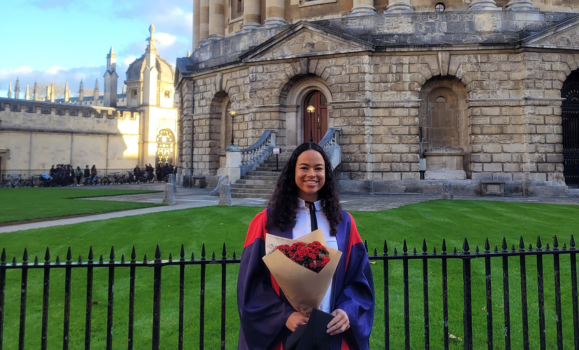
This realization shifted her trajectory, and she began studying for the MCAT, with a dream to return to Nova Scotia and pursue medicine at Dalhousie after her PhD.
She applied to Dalhousie Medicine through the BLAP, a program designed to increase representation and support for Black students in medicine. For her, the pathway wasn’t about making entrance to the program easier, but about building community.
“The biggest benefit is having that network of support,” she explains. “Having that community has been invaluable.”
Midway through her first year, Sierra is now active in the Black Medical Student Association and participates in initiatives like the Pulse program, which connects students with surgical mentors, offering workshops and hands-on experiences. She continues to be passionate about advocacy and equity and inclusion. Ìý
“Growing up in Dartmouth with strong ties to Cherrybrook, I saw firsthand how public health messaging during the pandemic affected African Nova Scotians,” she says. “I want to practice medicine in a culturally appropriate way, understanding the unique perspectives of those communities.”
The importance of representation
Ìý
Sierra’s journey from Dal Engineering to Oxford University in England, and back to Dalhousie Medicine highlights that persistence makes dreams possible, something she offers as advice to others facing limited representation.
“Use challenges as inspiration to prove people wrong,” she says. “Diversity isn’t just the right thing—it’s a strength. Your unique background and skills are valuable contributions, especially in fields like medicine and engineering where problem solving benefits from different perspectives.”
As Sierra looks ahead, she envisions a future where engineering and medicine intersect—whether through health technology, teaching, or advocacy. Her goal is clear: to make science accessible, empower communities, and inspire others to see diversity not as a barrier but as a powerful advantage.
Now read:
Dal student wins Rhodes Scholarship for work at the intersection of science and climate innovation