

Imagine it: You are a student who walks into class and the accommodation you require is in place. There are no last-minute emails or awkward reminders needed, just the comfort of knowing you're set up for success.
That鈥檚 the vision underpinning Dalhousie鈥檚 revised Student Accommodation Policy, adopted by Dalhousie Senate over the summer after an extensive review process led by a taskforce of faculty, staff, and students.
Quenta Adams, Dal鈥檚 assistant vice provost, student engagement and success, says the updated approach provides:
- greater clarity on roles and responsibilities;
- more reliable processes and dispute resolution;
- and a stronger and more detailed emphasis on inclusive education, spaces, services, policies, and communities.
The most meaningful change, says Adams, has been the creation of a new model in which Student Affairs and the Centre for Learning & Teaching (CLT) share responsibility for the policy鈥檚 success.
This change places the focus on our collective institutional responsibility to accessibility.
鈥淭his change places the focus on our collective institutional responsibility to accessibility and doesn't limit responses solely to a service unit, which tend to be reactive,鈥� says Adams, referring to the Student Accessibility Centre (SAC) 鈥� a unit of Student Affairs that held sole responsibility in the past.
That should mean a better experience for the thousands of students who need and request official accommodations each year at Dalhousie.
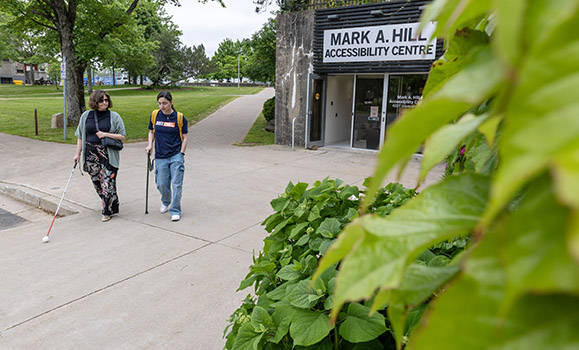
The Mark A. Hill Accessibility Centre, located on Studley Campus, offers quiet testing spaces.
Rick Ezekiel, vice-provost, student affairs at Dal, says there have been tremendous increases in participation in university among people with disabilities over the past 20 years, a development that has "rightfully challenged us to play our part."听
He says Dal's updated policy demonstrates its shared commitment to being a student-centred university that provides an exceptional and inclusive learning experience.
"Building a truly accessible learning environment for our students is everyone鈥檚 responsibility at Dalhousie," he says.
Building support
Dal plans to implement the policy in part through awareness and capacity-building.
While SAC still handles incoming accommodation requests from students, CLT has been brought in to play a more proactive role in sharing information with instructors and fostering more proactive course design to help mitigate barriers.
This past summer, the two units worked together to develop a resource guide on meeting student accommodations. The toolkit, , includes information about 18 of the most common access adjustments requested by students. These range from accessing lecture materials and permission to record lectures to assignment extensions and use of assistive technology during classes, tests, and exams.
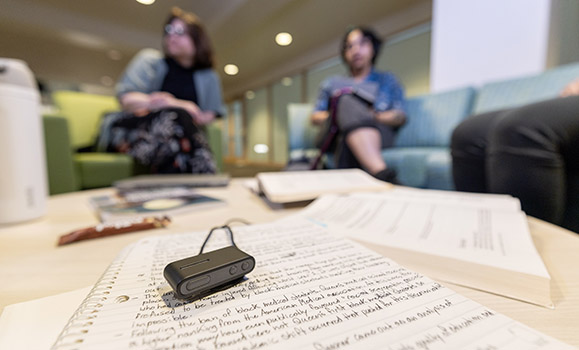
A wireless connect clip, shown above, can stream sound to an individual's hearing aids.
Each accommodation has its own dedicated page that lays out the reasons why a student might require that type of accommodation as well as advice on how a professor might meet it.
"What we've been hearing from faculty, for so long, is that they want to do all they can for students, but it's not always clear how to realize an accommodation within their unique disciplinary context," says Ben Tait, CLT鈥檚 director.
No one should have to hunt around for help
He says the reference guide has been informed directly by faculty experiences, and the pages will function as 鈥渓iving documents鈥� that can be updated as others share new ways to meet their duty to accommodate.
"These resources are a first step to better support in this area, and it's particularly important that the pages are linked in the initial accommodation letter: no one should have to hunt around for help," he says.听
No one-size-fits-all
Dal spent nearly a year reviewing and developing a revised policy, using best-practice frameworks from external agencies, an analysis of historical data and policy outcomes, and an environmental scan of other universities.
Surveys, open-ended input, and consultations with priority groups, faculty and senior leaders (deans, for example) helped inform the approach, which was further refined through an external review as well as feedback from Dal governance bodies such as Senate.
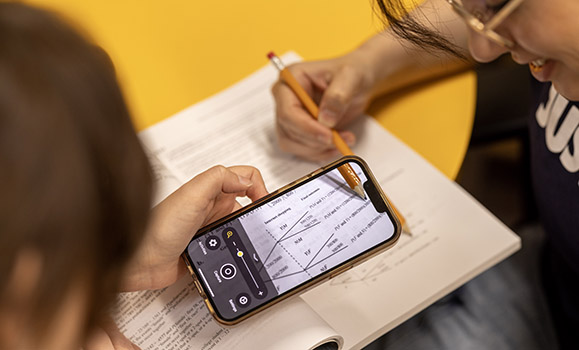
An iPhone's magnifying glass function offers more than just increasing size. It can be used to read text out loud, describe scenes, and more.
The resulting policy aligns well with the university鈥檚 broader Accessibility Plan, says Adams, who serves as co-chair of Dal鈥檚 Accessibility Advisory Committee.
By prioritizing inclusive design and barrier mitigation, the policy goes beyond simply responding to accommodation requests and towards a more systemic framework that will prevent the need for requests in the first place.
鈥淭here is no one size fits all for applying accommodations," she says. "All student situations are unique, so naturally new approaches to meeting them will be needed."