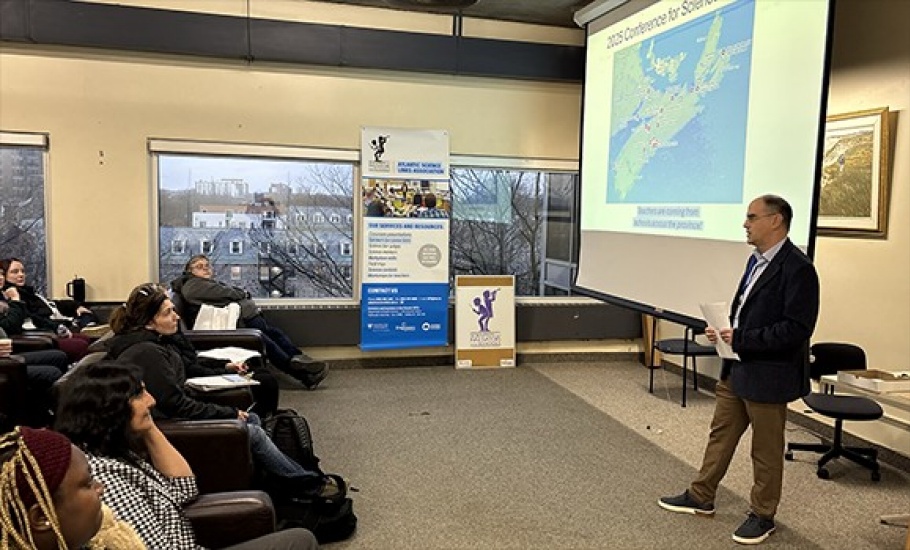

After a busy work week, it likely takes a lot for teachers to give up a day off.
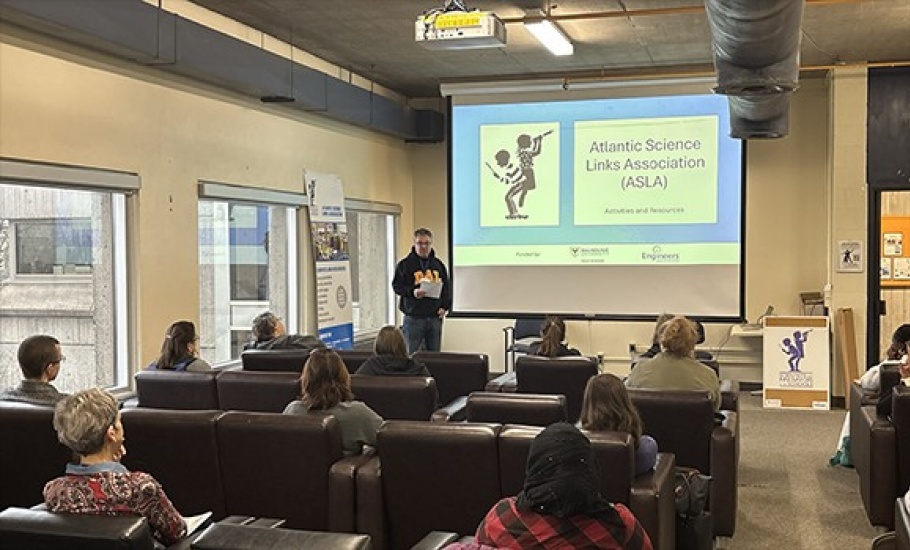
But the prospect of learning new ways of teaching scientific concepts and getting the tools to add them to their curriculum brought more than 20 educators from junior highs across Nova Scotia to Dalhousie last Saturday (Nov. 22).
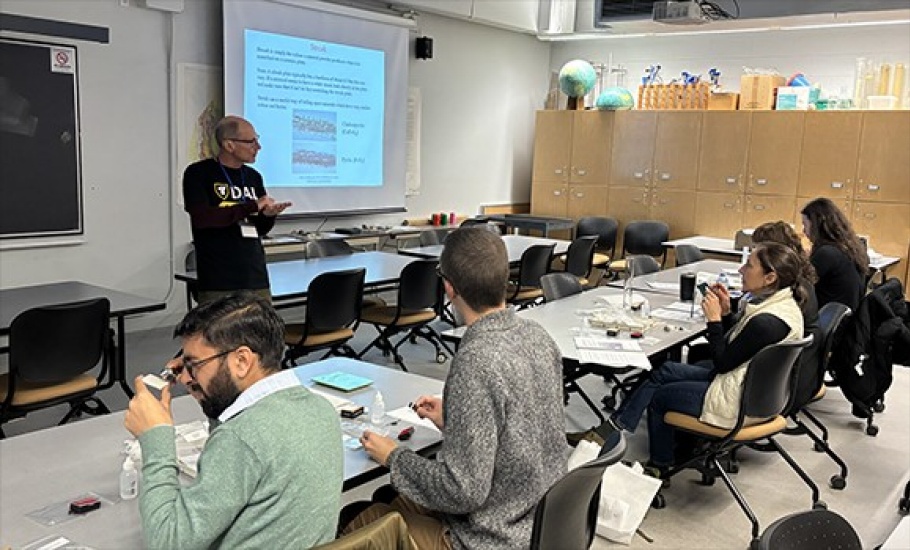
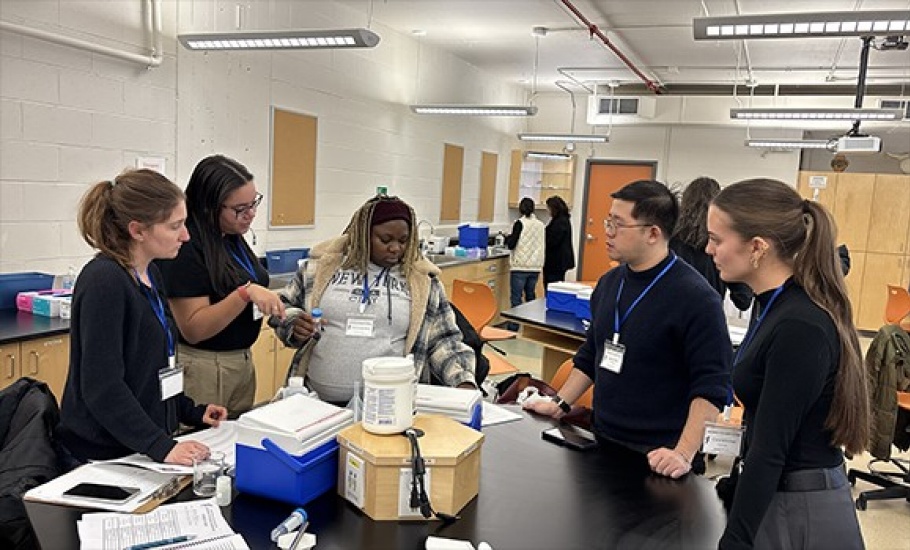
The converged on campus to take part in the latestÌý (ASLA) conference, attending four sessions facilitated by volunteer Dal science instructors on themes ranging from how to isolate DNA in strawberries to measuring plant biodiversity:
- Understanding and identifying mineral and crystal properties (Instructor: Dr. James Brenan with PhD student Peteris Rozenbaks)
- Meet your neighbours: Plants in and around the schoolyard (Instructor: Prof. Lara Gibson)
- Exploring DNA from fruit (Instructors: Postdoc James Kho and PhD student Tiara Mulder)
- : Exploring the ocean through immersive multimedia (Instructor: Dr. Boris Worm)
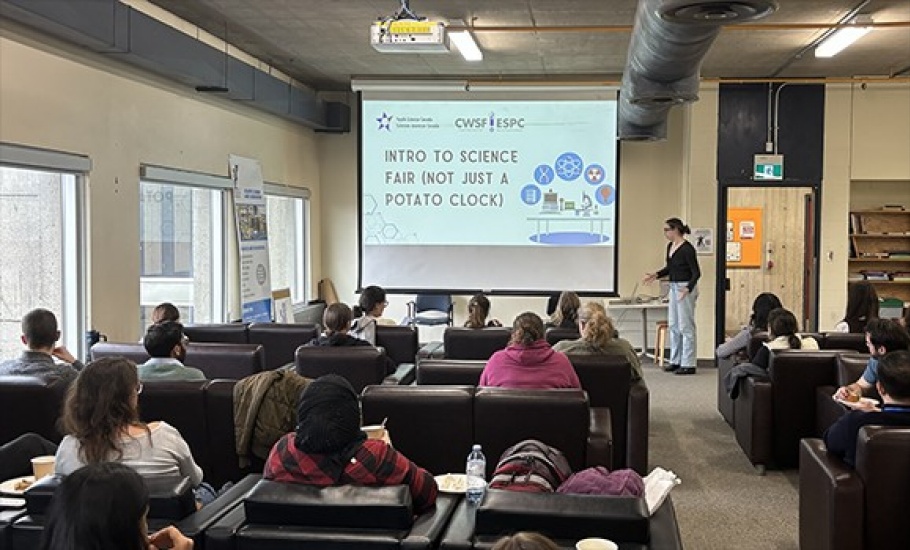
Chief Judge Julia Sarty also provided a lunchtime information session on running a successful science fair.
Dal-based ASLA has offered four such conferences since 2017.
No special gear requiredÌý
The activities demonstrated do not require specialized equipment or access to lab spaces sometimes hard to find in junior high schools.
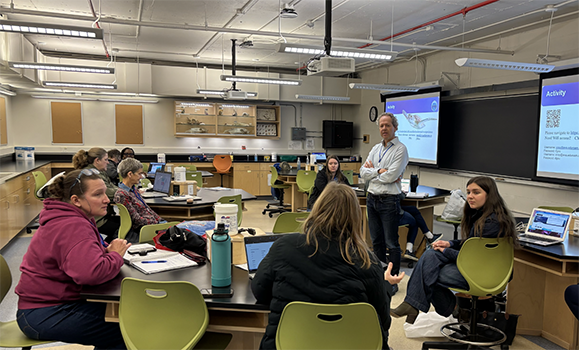
Dr. Boris Worm, standing, discusses Ocean School’s interactive ocean literacy resources.
“One of the barriers that I notice most in teaching science is accessing hands-on materials,” said DeAnne Pelchat, who teaches Grades 7-8 science, math, and health at Truro Middle School.
In the case of Ocean School’s interactive resources, which are designed to foster ocean literacy among junior high students, only a computer or tablet connected to the Internet is needed.
 Pelchat, who teaches French immersion, appreciated that the Ocean School content is bilingual, while fellow attendee Yolanda Ferrato, a Grade 6 French intensive teacher at Whitney Pier Memorial in Cape Breton, said she was quickly making plans to go over the resources with her colleagues.
“When you’re looking at it through the lens of ‘how can we apply this in our classroom,’ that’s when things really start to come alive,” said Ferrato.
Between sessions, attendees also got a glimpse of the Beaty Centre for Marine Biodiversity, located on campus and opening to the public in December. Ocean School content is incorporated throughout the Beaty Centre’s interactive displays.
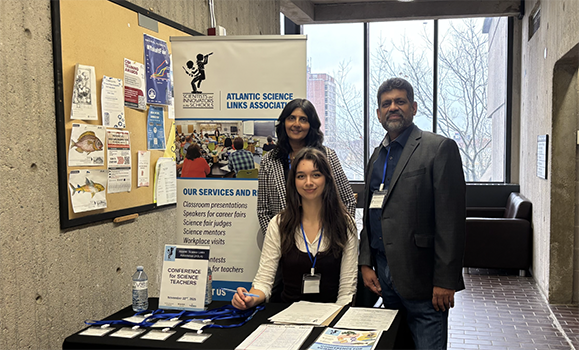
L-R: ASLA president Arunika Gunawardena, MSc student and ASLA administrative assistant Valerie Schagen, and ASLA executive director Rajesh Rajaselvam.
Building a brighter future in science
“Our mission is to bridge the gap between the scientific community, schools, and the public,” said Dr. Arunika Gunawardena, ASLA’s president and a Killam Professor in the Department of Biology. “We aim to inspire and engage students in science.”
Connecting with educators in a key part of that goal, added Professor Rajesh Rajaselvam, ASLA’s executive director and a University Teaching Fellow in the Department of Biology. “For teachers, we offer curriculum-aligned science conferences and contests to enrich their students’ learning experiences.”
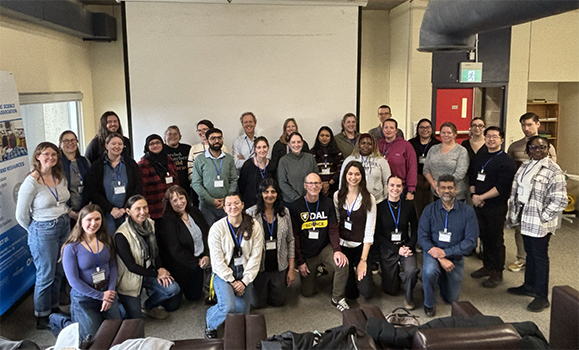
Teachers, instructors, and organizers gather for a group photo.
Planning is underway for the next edition of ASLA’s junior high science contest; in spring 2024, nearly 140 top finishers from across Nova Scotia attended an awards ceremony at Dal.
ASLA is also introducing a to connect girls in grades 10-12 with faculty and university students in the organization’s network.
“We believe that investing in students and youth today will help build a brighter future,” said Prof. Rajaselvam.
ASLA is grateful for the support of its volunteers, with funding provided by the Faculty of Science and Engineers Nova Scotia. Visit to learn more and get involved.